5 min read
Thai builds words from words
Published
There's a moment, three or four weeks into learning Thai, where you realise something quiet but important: most Thai words are made of other Thai words you already know. Not in some hand-wavy etymological sense — literally. The compounds are transparent, the construction is regular, and once you see the pattern you start being able to guess at vocabulary you've never been taught.
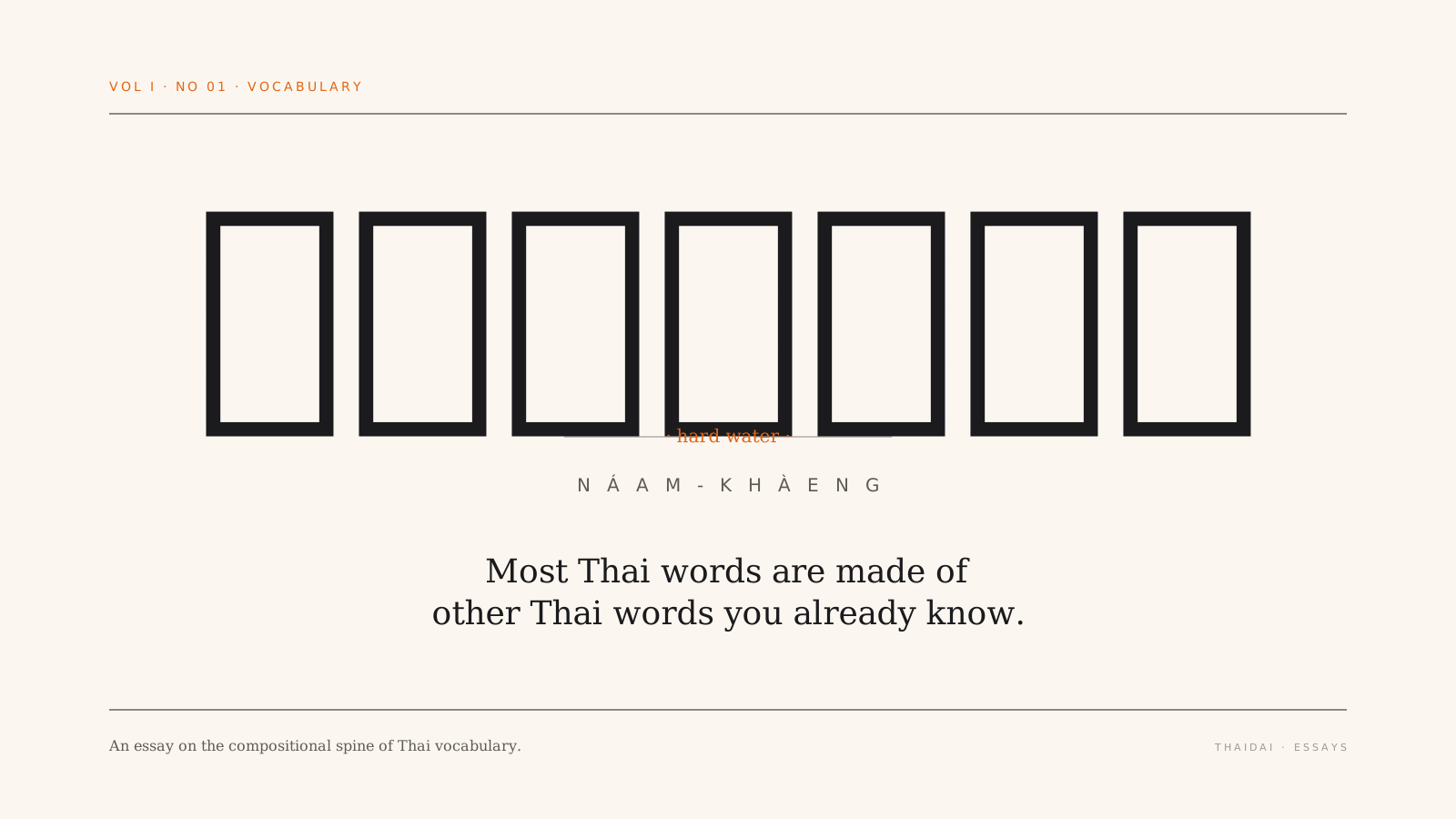
Take ice. In Thai, ice is น้ำแข็ง (naam-khaeng). Two syllables.
The first syllable is น้ำ, water. The second is แข็ง, hard. That's not a clever folk etymology. It's the actual word. A learner who knows water and hard can read "ice" off the script the first time they see it.
Now do bathroom:
Same pattern — "water room". The compositional logic is consistent.
Living room? ห้องนั่งเล่น (hawng-nang-len):
The Thai gives away its function: somewhere to sit and relax, not to dine or sleep. Breakfast is อาหารเช้า = อาหาร (food) + เช้า (morning). Lunch is อาหารกลางวัน (midday food). Dinner is อาหารเย็น (evening food). Once you have the pattern, you have the whole meal lexicon for free.
This is the thesis: Thai vocabulary is mostly Lego, not granite. English borrowed its abstract vocabulary from Latin and Greek and the seams don't show — "kitchen" doesn't decompose into morphemes a normal speaker can read. Thai borrowed less and built more, and the seams are right there in the script.
Why this matters for learners
The traditional way to learn vocabulary is brute force. Flashcard, repeat, hope it sticks. That works in English where most words are atomic units — but in Thai it leaves a third of your effort on the table, because you're memorising compounds as if they were primitive lexemes when they're actually shorthand for things you already know.
A better approach: learn the parts first, then watch the whole assemble itself. Once you have น้ำ (water), แข็ง (hard), ห้อง (room), อาหาร (food), เช้า (morning), เล่น (play), you can recognise — often produce — dozens of compound words you've never been formally taught. The signal-to-noise ratio of your study time goes up sharply.
This is also why "how many Thai words do I need?" is the wrong question. The right question is "how many atoms do I need?" — because each atom you learn is a partial credit on every compound it sits inside.
The system, made visible
Inside ThaiDai, every compound word and phrase carries a composesFrom list — the constituent atoms it's built from. We use that for two things:
Pedagogical gating. The practice engine won't show you a phrase until you've got the parts. If you haven't learned ใจ (heart) and เย็น (cool), it won't quiz you on ใจเย็น (calm — "cool heart"). You'd just memorise it as a single chunk and lose the underlying pattern.
Visual decomposition. Every compound shows its etymology on the card:
น้ำแข็ง (naam-khaeng, "ice") = น้ำ (naam, water) + แข็ง (khaeng, hard)
You see it once and it's no longer a word to memorise. It's an obvious construction.
The live breakdown across the corpus lives at /stats — words, phrases, atoms, and how the compositional engine sees them. Numbers are computed at render time from the actual deck, no rounding.
Where the pattern breaks
Not everything is compositional. Some words really are atomic — pronouns, basic verbs (ไป go, มา come, กิน eat), most numbers below ten, and a fair chunk of Sanskrit/Pali borrowings used in formal register. Some compounds are opaque even to native speakers — the etymology is there if you dig, but you wouldn't read it off cold. (English "breakfast" is technically "break + fast" but you don't think of it that way.)
The 80/20: maybe half of mid-frequency Thai vocabulary is transparently compositional. That's enough to fundamentally change how you study. The other half you handle the traditional way, but on a much smaller surface.
How to use this
Three practical moves:
1. Front-load the productive atoms. Words like ใจ (heart), น้ำ (water), ห้อง (room), อาหาร (food), ทาง (way), คน (person) sit inside dozens of compounds each. Learning these first multiplies the value of every later word.
2. When you meet a compound, decompose it explicitly. Don't just learn "ice = น้ำแข็ง". Learn "น้ำแข็ง = น้ำ + แข็ง = water + hard = ice". The decomposition costs nothing extra to memorise and pays back the next time you see either component.
3. Notice the patterns. If ห้องน้ำ is bathroom, what's ห้องนอน? (Bedroom — sleep room.) ห้องครัว? (Kitchen — cook room.) You can guess these correctly the first time, and the win is exhilarating. Use that.
This is the part of Thai that gets easier the longer you stay in it. The first 200 words feel like rote. The next 200 feel like discovery. By 1,000, you're recognising structure on sight and your apparent vocabulary is bigger than your actual study count would predict.
That's the compositional spine. It's why Thai is hard at first and unexpectedly logical once you trust the pattern.
Stop reading vocabulary lists. Start owning them.
ThaiDai's spaced-repetition deck brings each word back right before you forget it. 2,400+ hand-picked entries; the free tier covers the daily-survival set. Listening is built in.
Read next
- 11 min read
The first 100 Thai words to learn (and why)
The first 100 Thai words you learn cover roughly 50% of everyday conversation. Here are the right 100 — pronouns, verbs, particles, food — and why this set beats any phrasebook's top-100.
- 7 min read
Thai is simpler than you think
Most learners arrive expecting tonal-language difficulty or no-conjugation ease. Both are wrong. The real shape: Thai compresses what English elaborates, and the compression is doing real cultural work.
- 8 min read
How many Thai words do you need to be "fluent"?
Corpus linguistics gives a concrete answer — but the more useful question is what level of conversation you want to handle. Here are the numbers, and what they actually mean.