11 min read
The first 100 Thai words to learn (and why)
Published
People starting Thai always want a list. "Just give me the first 100 words." Most lists you'll find are wrong — not because the words aren't useful, but because they're the wrong 100. A list ordered by "how it feels" gives you "Saturday", "shopping", and "elephant" before you can string a sentence together. A list ordered by frequency in real spoken Thai gives you something completely different.
Here's what corpus linguistics says: the top 100 words in conversational Thai cover about half of everyday speech. Get-by Thai for free, in two weeks of daily practice, if the 100 are the right ones. We've put the right ones in tier 1 of ThaiDai's deck. This article explains the categories so you know what you're looking at.
The shape of the first 100
Roughly:
- 20 pronouns and basic question words — I, you, who, what, where, when, why
- 20 high-frequency verbs — go, come, stay, eat, do, want, have, can
- 15 particles — krap, ka, na, mai, laeo, gan, yang
- 10 numbers — one to ten, plus 100
- 10 polite framings — hello, thank you, sorry, excuse me, please, yes, no
- 15 essentials — water, food, money, person, thing, time, today, day
- 10 location and direction — here, there, near, far, in, out, up, down
Notice what's missing: animals, colours, weather, body parts, family-member nouns. Those all live in tier 2 (the next 900 words). They feel useful when you're imagining what you'll need, but they're rare in actual conversation. You can be in Thailand for a week and not say "elephant" once. You'll say "I" and "you" and "want" and "go" hundreds of times.
Pronouns and politeness particles do most of the lifting
Thai pronouns aren't optional the way English ones are. You can't drop the subject in Thai the way you can in Spanish or Italian — and you can't use the wrong politeness register without the conversation falling apart. So the first chunk of vocabulary you need is structural, not lexical.
For most learners that's:
- phom (I, men) / chan / dichan (I, women)
- khun (you, polite default) / phi (you, older) / nong (you, younger)
- rao (we) / khao (he, she, they)
- krap (polite particle, men) / ka / kha (polite particle, women)
- mai (no / not, depending on tone) / chai (yes, sort of — Thai doesn't have a clean yes/no, see below)
- na (softening particle)
That's 11 words. They appear in basically every sentence you'll ever say or hear. Get them tonally right (the difference between kha falling and kha high-rising matters) and the rest of the vocabulary you bolt on top has the right scaffolding.
The verbs that carry conversation
Twenty Thai verbs do roughly 80% of the verb-work in everyday speech. Eight of them do 80% of that 80%:
- bpai — to go
- maa — to come
- gin — to eat
- dai — to get / can / be able
- yuu — to be at / to stay
- mee — to have / there is
- chop — to like
- ruu — to know
You can construct a working day in Thailand with those eight plus the polite particles. "I'm going to eat" — phom bpai gin. "I have water" — phom mee naam. "Do you like it?" — khun chop mai. The grammatical patterns slot together cleanly because Thai is largely uninflected — verbs don't conjugate.
The next twelve fill out the corners: dtong (must), yaak (want), roo-jak (know a person/place), hen (see), fang (listen), phuut (speak), aan (read), khian (write), tham (do/make), suay (beautiful — a quasi-verb in Thai), suung (tall/high), hen-duay (agree).
After those 20 verbs you hit marginal returns — every additional verb is more situation-specific.
Numbers buy you a lot
Numbers 1–10, plus the multipliers (10, 100, 1000), let you handle:
- Prices in baht (haggling at markets, paying for taxis)
- Time of day ("two o'clock")
- Quantity ("five", "three days")
- Phone numbers ("nine eight zero …")
Ten numbers + their composition rule (sip-haa = "ten-five" = 15) covers a lot of mileage. The cost is small — numbers are mostly mono- or bi-syllabic and have predictable tones.
The full first 100 includes 1–10 plus sip (10), yee-sip (20), roi (100), phan (1000). That's enough for everyday transactions.
What about "yes" and "no"?
Thai doesn't have direct equivalents to yes and no. The language's "yes" depends on what you're agreeing with — for a question framed with mai ("…isn't it?"), you echo the verb; for chai mai ("right?") you say chai; for "do you want X?" you echo yaak or mai-yaak.
This is one of the biggest hurdles for English speakers, and the first 100 words include chai (correct / yes-ish), mai-chai (not correct / no-ish), and mai (no / not), plus some of the verbs you echo. Not having a clean yes/no feels weird for a week, then becomes natural.
A dedicated write-up on the yes/no mechanics is on the backlog — for now, the getting-started guide covers what you need to start using these in practice.
Why this list isn't a phrasebook
If you've used a phrasebook, you've seen lists like:
Hello — sa-wat-dee Thank you — khop khun Where is the bathroom? — hong naam yuu thee nai
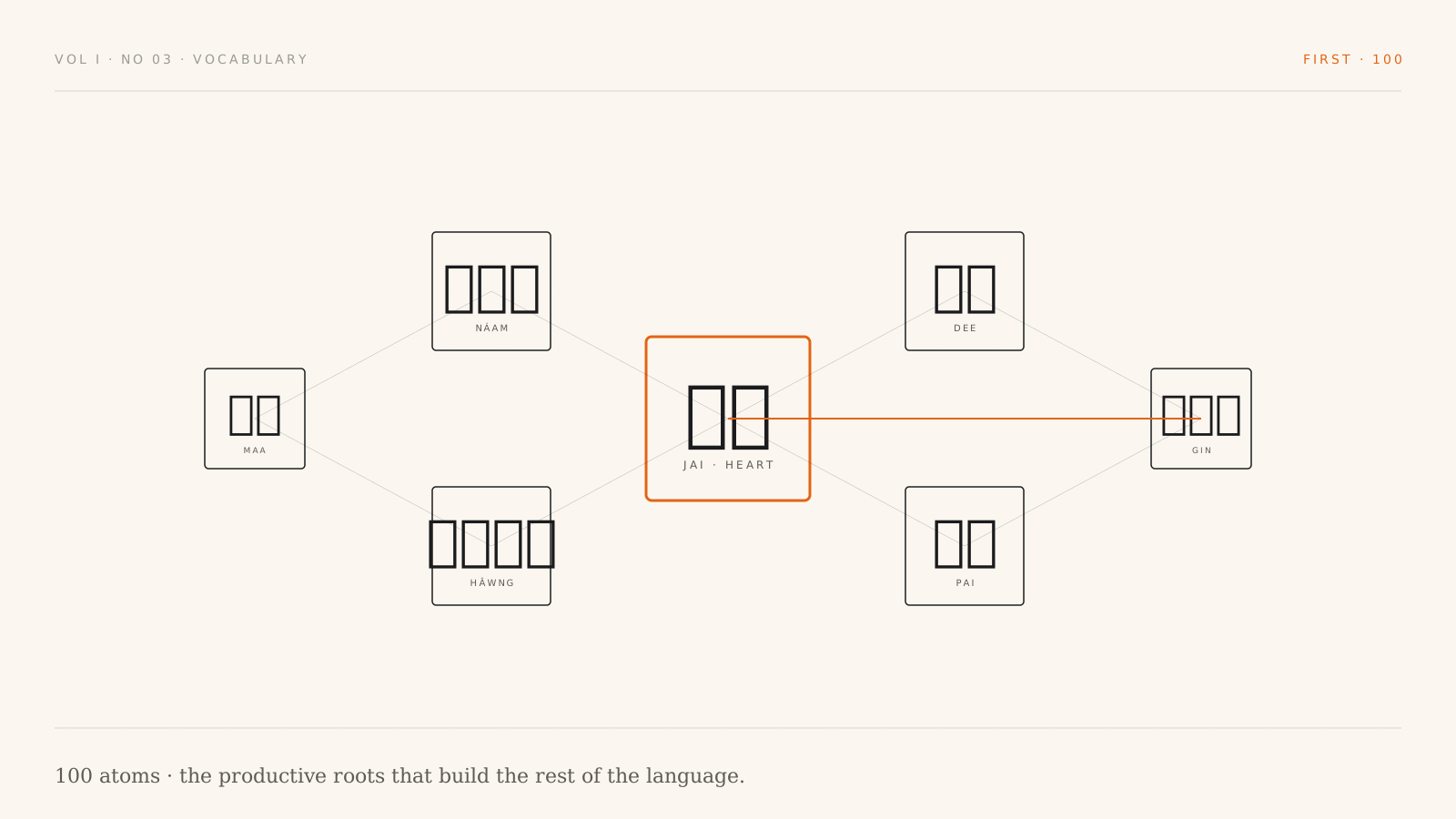
These are useful, but they're fixed phrases. You learn one expression and you can use it once. The first 100 words approach is different: you learn 100 atoms and combine them into a thousand sentences. Khop khun is two words you should know anyway. Hong naam yuu thee nai contains yuu (to be at) and thee nai (where) — both in the first 100.
The phrasebook gets you saying things faster. The frequency-list approach gets you constructing things faster. After two weeks of either, the frequency-list learner is generating their own sentences while the phrasebook learner is still memorising new ones.
How to actually learn the 100
Ten new words a day, eleven days. That's the realistic timeline if you do the daily-practice loop. It's not a sprint — and the SRS deck will hand you reviews of words you're still wobbly on, so you're not adding 10 to a stable base of 80, you're adding 10 to a base of about 50 confidently-known and 30-ish in-progress. By day 14 the whole 100 is in your active vocabulary.
ThaiDai's tier 1 is the first 100 words pre-curated. Free users get all of them by completing the first three lessons + a 7-day streak. (See how tiers work for the ramp.) After that the next 900 words take you from 50% comprehension to 80% — the next big jump in coverage.
A note on order
Don't try to learn the 100 in any particular order. The right order is "whichever ones the SRS deck shows you next". Frequency lists are great for the selection; for the ordering, you want spaced repetition. The deck will show you the high-frequency words more often anyway because they appear in more lessons.
If you want a cold-start hand-pick, learn:
- sa-wat-dee + khop khun (hello, thank you) — day-one polite framing
- phom / chan + khun (I + you) — pronoun pair
- krap / ka (polite particles) — every sentence
- gin + bpai + maa (eat, go, come) — three verbs to anchor
- naam + khao (water, rice) — two essential nouns
That's nine words. With those you can buy a meal politely. The next ten add the question-formers (nai, arai, thaorai) and you're holding a basic conversation.
The whole first 100 takes two weeks. After that, three months of daily practice gets you to 1000. A year gets you to 3000. The compounding is the magic — every new word you add is one more anchor for the next ten.
Hear four words
- สวัสดีhello / greetings (bare)
- ขอบคุณthank you (bare)
- สบายดีไหมHow are you?
- กินto eat
Get started with ThaiDai if you want the deck pre-built. Or take the list above and write your own flashcards — the method works either way.
Stop reading vocabulary lists. Start owning them.
ThaiDai's spaced-repetition deck brings each word back right before you forget it. 2,400+ hand-picked entries; the free tier covers the daily-survival set. Listening is built in.
Read next
- 8 min read
How many Thai words do you need to be "fluent"?
Corpus linguistics gives a concrete answer — but the more useful question is what level of conversation you want to handle. Here are the numbers, and what they actually mean.
- 6 min read
Getting started with ThaiDai
A practical 10-minute walkthrough — picking your first 100 Thai words, setting a daily goal, and turning the practice deck into something you actually use.
- 7 min read
The daily-practice loop
Why ten minutes a day beats two hours on Sunday, how spaced repetition actually works, and the small habit hacks that make Thai stick.