9 min read
Thai tones, explained for English speakers
Published
Thai has five tones. One Thai syllable, said five different ways, can mean five completely different things. Yes, this trips everyone up. The good news: tones are systematic. Once you have the mental model, the rest is repetition.
The classic example
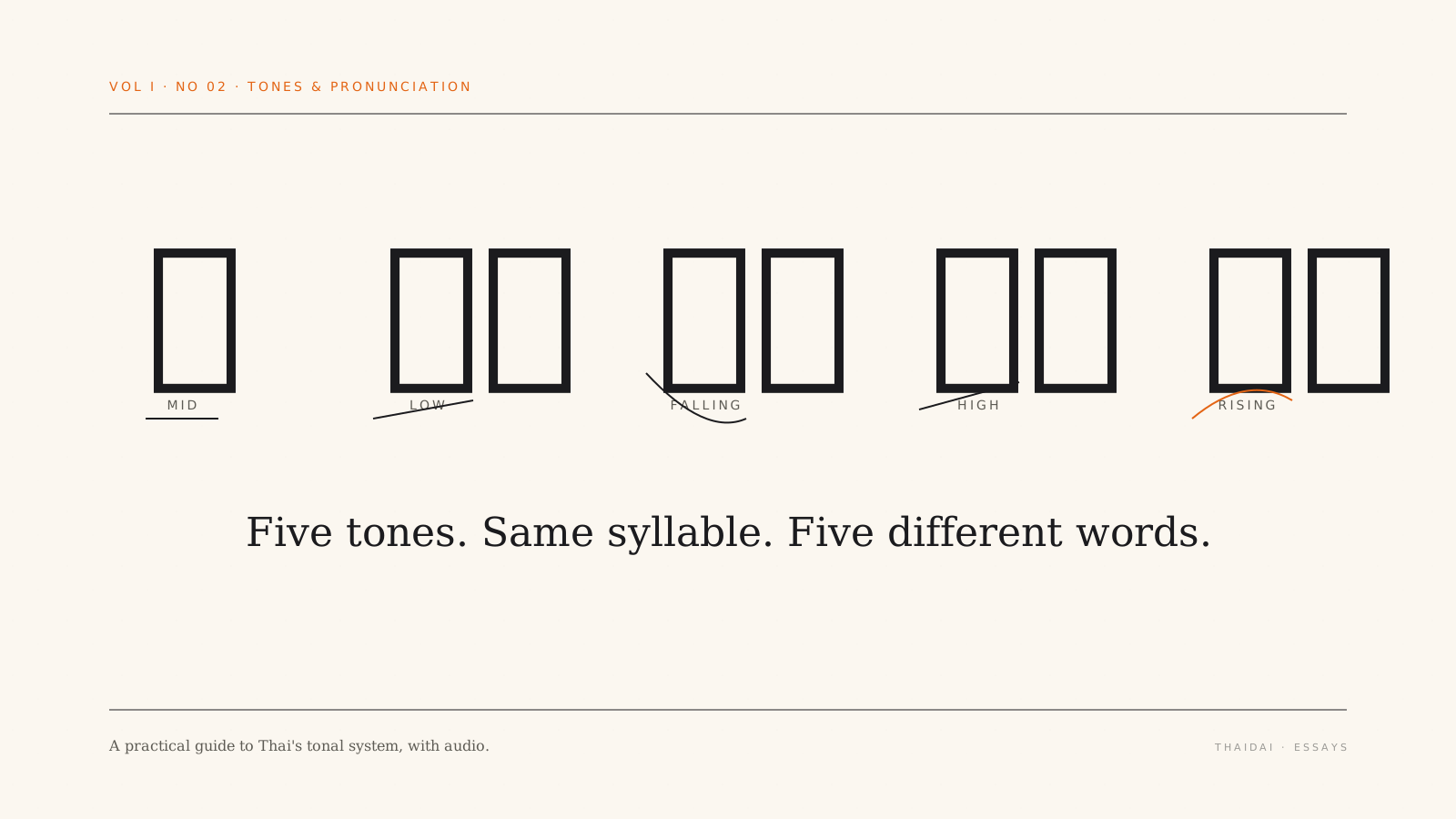
The syllable มา ("maa") changes meaning entirely based on tone:
- Mid tone — มา (maa) — "to come"
- Low tone — หม่า (màa) — used in names; rare alone
- Falling tone — ม้า (mâa) — "horse"
- High tone — ม๊า (máa) — colloquial "mum"
- Rising tone — หมา (mǎa) — "dog"
Saying "the dog is here" with a falling tone instead of a rising one means "the horse is here". Same vowel, same consonants, different pitch contour, completely different sentence.
What each tone actually sounds like
The names are descriptive — pitch is what matters, not the label. Think of them as shapes drawn on a graph from low to high pitch.
Mid tone
Flat, in your speaking range, neither rising nor falling. The default. If you say "yeah" back to someone in English without any expression, that's roughly the contour.
Low tone
Flat, but at the bottom of your speaking range. Like the disappointed "oh." you give when bad news arrives. English speakers often confuse this with the falling tone — the difference is that low is flat-low, falling moves downward.
Falling tone
Starts high, drops sharply. The English equivalent is the emphatic "no!" you give a dog jumping on the sofa. The pitch contour does the work, not the volume.
High tone
Held at the top of your speaking range, with a slight rise into it. Closer to a flat-high contour than a sharp rise. The most commonly mispronounced tone for native English speakers, who tend to soften it into a mid.
Rising tone
Starts low, rises into a high. Equivalent to the questioning "really?" in English — an upward swoop. This one feels intuitive to most English speakers because we already have it in question intonation.
Why English speakers struggle
English has pitch — but we use it for emphasis, mood, and questions, not for word meaning. Saying "BANK" loud and "bank" quiet means the same thing. In Thai, that pitch is the word.
Two specific failure modes show up early:
- Question intonation creep. When asking "where is the train station?" English speakers default to upward intonation on the last word. In Thai, that turns the last word into a different word.
- Stress masquerading as tone. We compress unstressed syllables and emphasise stressed ones. In Thai every syllable carries its own tone, every time. There are no "throwaway" syllables.
How ThaiDai helps
Every audio clip in ThaiDai is generated by a native-trained Thai voice. Pair it with the romanisation, which encodes the tone explicitly (à for low, á for high, â for falling, ǎ for rising — mid is unmarked), and you have both the sound and the shape it should make.
The practice deck pairs minimal-pair words (like มา / ม้า / หมา) so you train the discrimination directly. The breakthrough moment for most learners isn't "I learned the rules" — it's "I can now tell horse and dog apart".
Practical exercises
- Pick one tone per day. Listen to ten words in that tone. Repeat each five times.
- Record yourself saying a word, then play the native audio after. The gap between them is your training signal.
- Don't worry about getting it perfect in week one. The ear comes first; the mouth follows.
Hear four words
- ไม่not (negation)
- ไหมquestion particle
- น้ำwater
- มาto come (toward speaker)
Read next: the daily-practice loop — or get going with ThaiDai itself.
Drill the tones, hear the difference.
Every word in the deck plays in a native-trained Thai voice. The minimal-pair drills (มา / ม้า / หมา) train your ear directly. Free tier covers the foundational set — get started in two minutes.
Read next
- 6 min read
Getting started with ThaiDai
A practical 10-minute walkthrough — picking your first 100 Thai words, setting a daily goal, and turning the practice deck into something you actually use.
- 7 min read
The daily-practice loop
Why ten minutes a day beats two hours on Sunday, how spaced repetition actually works, and the small habit hacks that make Thai stick.