8 min read
How to order food in Thai (without ending up with a surprise)
Published
There's a moment, somewhere around your fifth meal in Thailand, when you realise that the menu in English exists for you and nobody else. The Thai menu has more dishes, the prices are sometimes better, and the kitchen takes you slightly more seriously when you order from it.
You don't need much to cross over. Thirty phrases will get you ordering from a Thai-language menu, customising your dish, and handling the pay-and-leave dance without any of it feeling like a performance.
Here's the kit.
Sitting down
You walk into a place. Someone behind the counter looks at you. The opening move:
| English | Thai | Pronunciation |
|---|---|---|
| Table for two | โต๊ะสำหรับสองคน | tó sǎm-ràp sǒng kon |
| Just one | คนเดียว | kon dieow |
| Can I sit here? | นั่งตรงนี้ได้ไหม | nâng trong níi dâi mái |
| Outside / inside | ข้างนอก / ข้างใน | kâang nôk / kâang nai |
Most casual places won't ask — you sit, they bring water, you order. The phrase nâng trong níi dâi mái? ("can I sit here?") is mainly for places with a clear host, or when you're not sure if a table is reserved.
If it's busy and someone gestures at a chair across from you, the polite move is to nod and move your bag. Thai casual restaurants are often share-table. This isn't rude; refusing the share is more eyebrow-raising than accepting it.
Reading the menu
Most menus you'll see start with rice and noodle dishes, then proteins, then drinks. The structural words to recognise:
- ข้าว (kâao) — rice
- ก๋วยเตี๋ยว (gǔay-tǐeow) — noodles (generic)
- ผัด (pàt) — stir-fried
- ทอด (tôt) — fried (deep-fried, usually)
- ย่าง (yâang) — grilled
- ต้ม (tôm) — boiled / soup
- แกง (gaeng) — curry
- หมู / ไก่ / เนื้อ / กุ้ง / ปลา (mǔu / gài / núea / gûng / plaa) — pork / chicken / beef / shrimp / fish
You can read about 70% of any menu by recognising those eleven words plus the dish you want. kâao pàt gài is "stir-fried rice with chicken" — fried rice with chicken. gǔay-tǐeow núea is "noodles with beef". The grammar is just nouns stacked next to each other, no prepositions.
Ordering
The minimum viable order is one phrase:
- เอา X (ao X) — "I'll have X"
That's it. Point if you have to. ao kâao pàt gài nèung jaan — "one plate of chicken fried rice".
A few softening additions if you want to sound less like a robot:
| English | Thai | Pronunciation |
|---|---|---|
| I'd like to order | ขอสั่งอาหาร | kɔ̌ sàng aa-hǎan |
| Can I have… | ขอ… | kɔ̌ |
| One plate of | …หนึ่งจาน | nèung jaan |
| Two bowls of | …สองชาม | sǒng chaam |
| One glass / bottle of | …แก้ว / ขวด | gâew / kùat |
The pattern: kɔ̌ dish number classifier. kɔ̌ kâao pàt gài nèung jaan — "may I have one plate of chicken fried rice". The classifier matters; saying kɔ̌ kâao pàt gài nèung alone sounds like an unfinished sentence to a Thai ear.
The classifiers worth knowing:
- จาน (jaan) — plate (rice dishes, single-protein dishes)
- ชาม (chaam) — bowl (noodles, soup)
- แก้ว (gâew) — glass (drinks, cold)
- ขวด (kùat) — bottle (water, beer)
- กระป๋อง (grà-pǎwng) — can (Coke, beer)
- ที่ (tîi) — portion (used for "one of these" when nothing else fits)
If you can't remember the right classifier, tîi works as a fallback. kɔ̌ X nèung tîi — "may I have one of these" — is universally understood, slightly informal, and rescues you from any classifier you forgot.
Customising
This is where ordering in Thai pays off. The English menu rarely has the customisation options; the Thai-speaking customer always does.
| English | Thai | Pronunciation |
|---|---|---|
| Not spicy | ไม่เผ็ด | mâi pèt |
| A little spicy | เผ็ดน้อย | pèt nɔ́i |
| Very spicy | เผ็ดมาก | pèt mâak |
| No fish sauce | ไม่ใส่น้ำปลา | mâi sài náam-plaa |
| No MSG | ไม่ใส่ผงชูรส | mâi sài pǒng-chuu-rót |
| No coriander | ไม่ใส่ผักชี | mâi sài pàk-chii |
| No sugar | ไม่ใส่น้ำตาล | mâi sài náam-taan |
| No ice | ไม่ใส่น้ำแข็ง | mâi sài náam-kǎeng |
| Extra (something) | ขอเพิ่ม X | kɔ̌ pôem X |
| Take out / takeaway | ใส่ห่อ / กลับบ้าน | sài hɔ̀ / glàp bâan |
A note on mâi pèt ("not spicy"). Thai cooks have a sliding scale of "not spicy" that runs from "actually mild" through "still meaningfully spicy by farang standards" to "what part of my request was unclear". If you're heat-sensitive, mâi pèt loei — "not spicy at all" — is the version that gets through. Add kâ / kráp to soften it.
The no coriander phrase is the single most useful one for many travellers. Thai cooking uses raw coriander everywhere, even for the five percent of the population that has the genetic variant that makes it taste like soap. Worth memorising on day one.
Asking what something is
When you've pointed at a dish on a menu and want to know what's in it before committing:
| English | Thai | Pronunciation |
|---|---|---|
| What's this? | นี่อะไร | nîi a-rai |
| Is it spicy? | เผ็ดมั้ย | pèt mái |
| Does it have meat? | มีเนื้อมั้ย | mii núea mái |
| Is it pork? | หมูใช่มั้ย | mǔu châi mái |
| What's good here? | อะไรอร่อย | a-rai a-rɔ̀i |
| What do you recommend? | แนะนำอะไรดี | náe-nam a-rai dii |
a-rai a-rɔ̀i? — "what's tasty?" — is the move that gets the staff actually engaged. Most Thai cooks have opinions, and asking implies you trust them. The dish that comes out is usually the one they're proud of.
Paying
| English | Thai | Pronunciation |
|---|---|---|
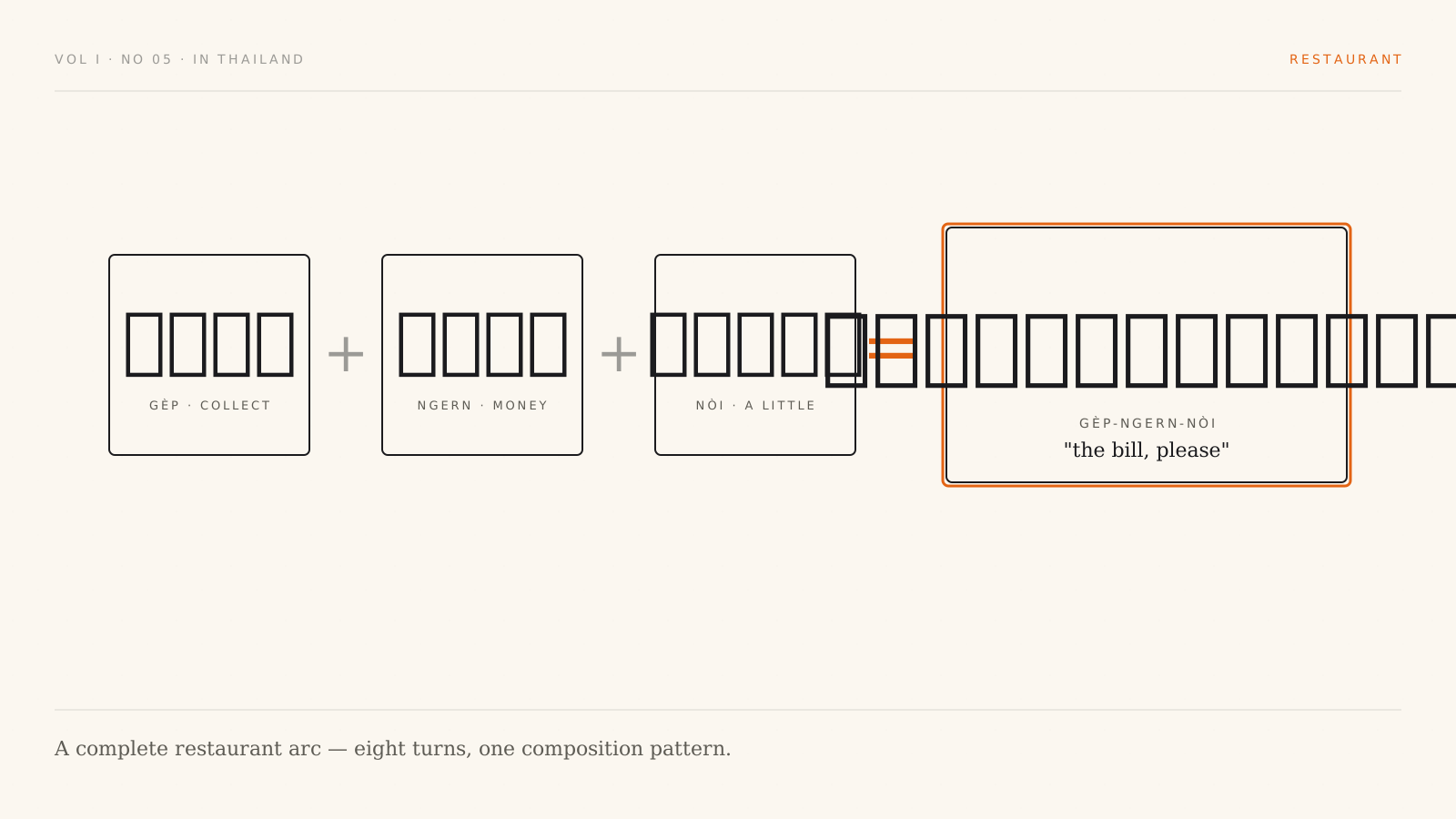
| Bill, please | เก็บเงิน | gèp-ngern |
| Check, please | เช็คบิล | chék-bin |
| How much? | เท่าไหร่ | tâo-rài |
| Can I pay by card? | จ่ายบัตรได้มั้ย | jàai bàt dâi mái |
| Cash only | เงินสดเท่านั้น | ngern-sòt tâo-nán |
Both gèp-ngern and chék-bin work. chék-bin is borrowed from English and feels slightly more upscale; gèp-ngern is what you'll hear at street stalls and casual places. Either is fine anywhere.
Cash is still the default at most casual restaurants. Cards work at bigger places, malls, and cafés; QR-code mobile payment (PromptPay) is increasingly universal but requires a Thai bank account. Carry small notes — change for a 1000 baht note at a 50 baht stall is the wrong battle.
Tipping
Thailand isn't a tipping culture, but the rules vary:
- Casual restaurants and street food. No tip expected. Round up if you want.
- Sit-down restaurants. Leave the small change, or 20-50 baht.
- Hotel restaurants and upmarket places. A 10% service charge is often added; if not, leave 10%.
Tipping isn't expected the way it is in the US, and over-tipping isn't generous — it's slightly awkward. Round numbers, small amounts, no big production.
The polite-particle reminder
Add ครับ (kráp, men) or ค่ะ (kâ, women) to the end of every request and the temperature of the conversation goes up by a notch. kɔ̌ kâao pàt gài kráp feels markedly different from kɔ̌ kâao pàt gài alone.
This isn't grovelling; it's the bare minimum politeness expected of an adult. Skipping it is the equivalent of walking up to a barista in your own country and saying "coffee" instead of "could I get a coffee, please". You'll be served either way; one is what you actually want to be doing.
We have a longer write-up on krap and ka if the particle system feels weird. The 30 phrases for travellers covers the rest of the situations you'll hit beyond the restaurant.
You'll meet these phrases this week.
ThaiDai's scenarios cover ordering food, taxis, hotels, markets — what you'll actually use in the next few days. The free tier opens the deck; Pro unlocks the full set.
Read next
- 12 min read
30 Thai phrases for travellers (the ones that actually help)
A no-fluff list of the Thai phrases that move a tourist from confused to functional. Greetings, ordering food, getting around, dealing with situations — and why a phrasebook stops working at phrase 31.
- 7 min read
How to be polite in Thai: krap, ka, and beyond
The polite particles are the easy part. The harder layers — pronouns, softening words, and tone of voice — are what actually make the difference. A practical guide.
- 6 min read
Getting started with ThaiDai
A practical 10-minute walkthrough — picking your first 100 Thai words, setting a daily goal, and turning the practice deck into something you actually use.